Most people think bruxism happens at night. For a large share of the working population in Birmingham, it is happening right now — jaw locked, teeth touching, shoulders up, halfway through a spreadsheet.
There Are Two Kinds of Bruxism, and Most People Have the Wrong One in Mind
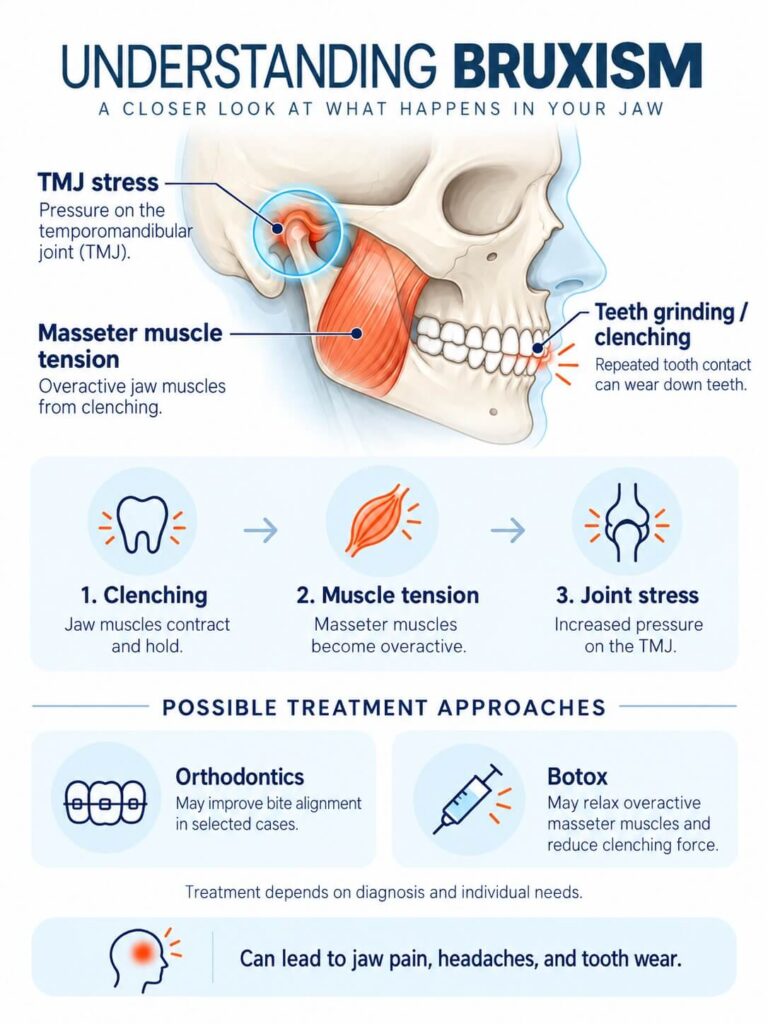
Bruxism is the clinical term for grinding or clenching your teeth. What is less widely understood is that it comes in two distinct forms, with different causes, different symptoms and different treatment paths.
Sleep bruxism is the version everyone knows about. It happens unconsciously during the night, often in bursts tied to shifts in sleep depth. It is loud enough that a partner usually notices before the patient does, and it tends to produce the most dramatic tooth wear.
Awake bruxism is the version that goes undiagnosed for years. It is not usually grinding at all — it is sustained, low-grade clenching, held for minutes at a time during concentration, deadlines, difficult emails or heavy traffic. It makes no noise. Nobody hears it. And because the jaw never fully relaxes, the muscle stays under load for hours a day.
The Signs You Can Check Right Now
Bruxism is usually diagnosed by a dentist long before the patient suspects anything, because the damage shows up on the teeth before it shows up as pain. These are the signals worth taking seriously.
Signs of Awake Clenching
- You catch your teeth touching when you are concentrating — at rest, they should not be in contact
- A dull ache in the jaw or temples that builds through the afternoon rather than being worst on waking
- Tightness or fatigue in the jaw after long meetings, long drives or long screen sessions
- Ridging along the inside of your cheeks, or scalloped indentations along the edges of your tongue
Signs of Sleep Grinding
- Waking with a stiff, tired or locked jaw
- Headaches concentrated at the temples first thing in the morning
- Teeth that have become sensitive to hot and cold without any obvious decay
- A partner who has mentioned the noise
- Flattened, chipped or shortened front teeth — particularly an edge that has become straight and level rather than naturally contoured
One symptom on its own means little. Three or four together is a pattern worth having examined.
What Untreated Grinding Actually Costs
Bruxism is rarely urgent, which is exactly why it gets deferred. The problem is that the damage is cumulative and, past a certain point, irreversible — enamel does not grow back.
The progression is predictable. Enamel wears first, which is painless and invisible to the patient. Once it is through to the dentine underneath, sensitivity starts and the wear accelerates, because dentine is considerably softer. From there you move into cracked cusps, failing fillings, teeth that fracture under normal chewing load, and eventually shortened teeth that change the way the bite closes and the way the lower face sits.
The video explores bruxism (teeth grinding) and how it can damage the teeth, jaw muscles and quality of sleep.
One sufferer explains how anxiety and obsessive-compulsive disorder (OCD) can worsen her grinding, causing pain and exhaustion.
Stress, medication and sleep problems may all contribute, so identifying the underlying cause is essential.
If you grind or clench your teeth, it is worth seeing a dentist to assess whether treatments such as an occlusal splint, Botox or orthodontic treatment could help.
How Bruxism Is Treated at RIT Dental Birmingham
There is no single cure for bruxism, and any clinic that promises one is overstating the evidence. What there is, is a set of interventions that protect the teeth, reduce the muscle load and address what is driving the habit — usually combined rather than used alone.
Frequently Asked Questions About Bruxism
Can bruxism be cured permanently?
Not reliably, no. Bruxism is a behaviour rather than a disease, and it tends to fluctuate with stress and sleep quality across a lifetime. What can be achieved consistently is control: protecting the teeth from further damage, reducing muscle pain, and cutting the frequency of episodes by managing the triggers.
How much does a night guard cost in the UK?
Custom-made guards vary with the material and the thickness required, which in turn depends on how heavy your grinding is. A light-duty soft guard sits at the lower end; a hard acrylic guard built for heavy grinders costs more and lasts considerably longer. We quote in writing after the assessment, once we know which is clinically appropriate — quoting before examining the wear pattern would be guesswork.
Can my dentist tell if I grind my teeth?
Almost always, and usually before you have any symptoms. The wear facets left by grinding are distinctive and do not look like ordinary age-related wear — they are flat, polished, and match up precisely between the upper and lower teeth when the jaw moves sideways.
Is teeth grinding treatment available on the NHS?
NHS provision for bruxism appliances is limited and varies by practice and by clinical need, and access to NHS dentistry in Birmingham is constrained in general. RIT Dental Birmingham provides care on a private basis only.
Does stress alone cause bruxism?
Stress is the most commonly identified factor, but it is not the only one. Sleep-disordered breathing, some antidepressant medications, high caffeine or alcohol intake, and an uneven bite can all contribute. That is why the assessment covers more than just the teeth.
Will a night guard stop my headaches?
Frequently, yes — where the headaches originate in overworked jaw muscles, reducing the overnight load tends to reduce the morning headache. It is not a guarantee, and headaches have many causes. If they persist once the grinding is controlled, that is a signal to investigate further rather than to accept them.
Book a Bruxism Assessment in Birmingham
If you are waking with a tight jaw, catching yourself clenching during the working day, or noticing that your front teeth are shorter and flatter than they used to be, the useful move is to have it looked at while the only thing you have lost is comfort, link https://birmingham.ritdental.co.uk/private-dentist/
RIT Dental Care Birmingham is at 147 Great Charles Street Queensway, Birmingham B3 3LP, in the city centre. Call 0742 855 2661 or message us on WhatsApp to arrange a teeth grinding consultation.